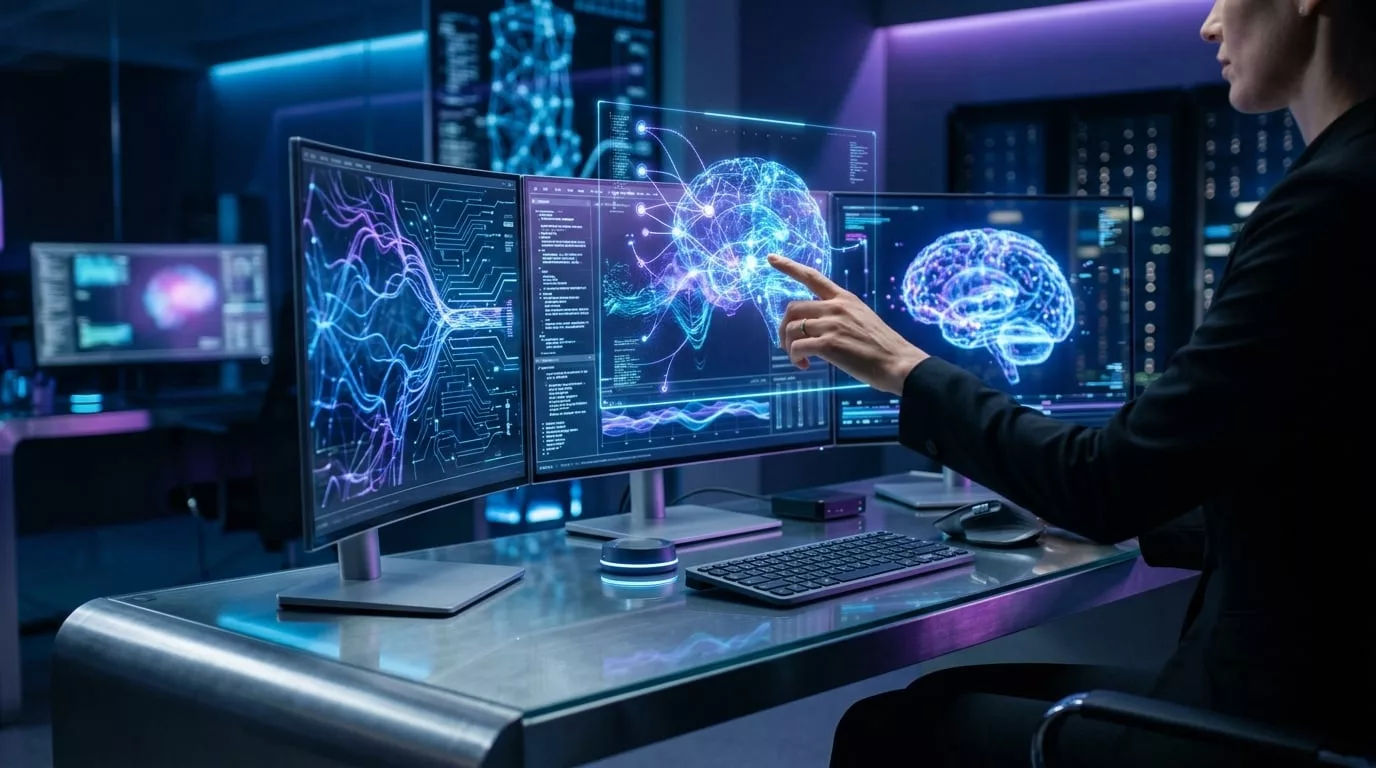
The Future of AI in Computing
Artificial intelligence is quickly moving from a helpful add-on to a core part of how computers work. In the near future, AI won’t just live inside chatbots and image generators; it will shape operating systems, software development, cybersecurity, hardware design, and even the way ordinary users interact with their devices. Computers are becoming more adaptive, more conversational, and more capable of understanding context instead of waiting for exact commands. That shift could change computing as deeply as the mouse, the touchscreen, or the cloud once did.
AI is already helping computers predict what users want, automate repetitive work, detect anomalies, and generate code or content on demand. As models improve and run more efficiently on local devices, the boundary between “using a computer” and “working with an intelligent assistant” will continue to blur. The result may be a computing experience that feels less technical, more personal, and far more powerful.
Boomer Perspective — AI as a Productivity Supercharger
From an optimistic point of view, AI is the next great computing breakthrough. For many people, the biggest benefit will be productivity. Tasks that once took hours—sorting data, writing boilerplate code, troubleshooting errors, summarizing documents, or organizing workflows—can be handled in minutes. That frees humans to focus on strategy, creativity, and decision-making instead of routine digital busywork.
AI also has the potential to democratize computing. People who are not programmers can increasingly build software, analyze information, and automate tasks simply by describing what they need in plain language. This lowers the barrier to entry and makes advanced computing tools accessible to students, small businesses, and independent creators.
Another positive angle is that AI can expand what computers are capable of. Devices may become better at translation, accessibility, simulation, and personalization. A laptop could act like a tutor, a coder, a designer, and a research assistant all at once. In this view, AI doesn’t replace computing—it elevates it.
Doomer Perspective — AI as a Risk Multiplier
The pessimistic view is that AI may make computers more powerful in ways that are not always good for people. One major concern is job displacement. If AI can write code, manage support tickets, generate reports, and perform many administrative tasks, then some roles may shrink or disappear entirely. Even if new jobs emerge, the transition could be painful and uneven.
Security is another serious issue. AI can help defenders detect threats, but it can also help attackers write phishing emails, find vulnerabilities, and automate malware creation. As computers become more AI-driven, the attack surface grows, and mistakes made by models may have real-world consequences.
There is also the risk of over-reliance. If users depend too heavily on AI tools, they may lose important skills such as debugging, critical thinking, writing, and memory. When everything is optimized by a machine, people may understand less about how their systems actually work. That could create a generation of users who are highly productive but less technically resilient.
A Balanced View
The most realistic future lies somewhere between these extremes. AI will almost certainly make computers more useful, intuitive, and accessible. It will also create disruption, especially in jobs, security, and technical literacy. The key question is not whether AI will transform computing—it already is—but whether that transformation is guided carefully.
If developers build transparent systems, businesses invest in training, and users stay curious rather than passive, AI can become a tool that amplifies human ability instead of replacing it. The future of computing is likely to be more intelligent, but it should also remain understandable, secure, and human-centered. The winners will be those who learn to work with AI without forgetting how to think for themselves.