How AI Could Reshape Learning Websites
Wajih Alkhiami — July 22, 2026
From Content Libraries to Adaptive Learning
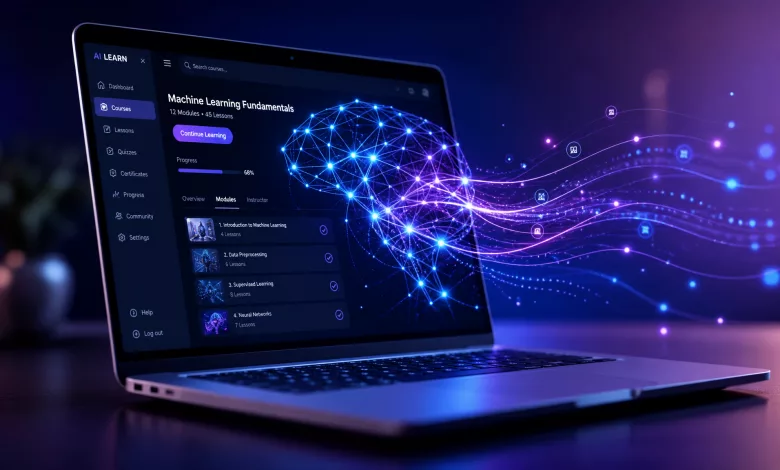
Learning websites are likely to evolve from largely static collections of lessons into more responsive environments. AI-powered systems can already track progress, identify misconceptions, adjust content sequences, and provide immediate feedback. Generative AI adds conversational explanations, automated question creation, and context-aware dialogue, while multimodal systems can combine text, speech, and visual material.
Evidence offers grounds for measured optimism. A meta-analysis of U.S. K–12 intelligent tutoring systems found a positive effect on academic achievement of g=0.271. Some studies report larger gains in particular settings, but results vary by age group, subject, and implementation quality. Researchers continue to call for larger samples and validation periods of at least six weeks, so short-term improvements should not be treated as proof of lasting learning.
Adoption is already substantial: about 37% of teachers across OECD education systems used generative AI for work-related activities in 2024. Yet usage ranged from roughly 75% in Singapore and the United Arab Emirates to below 20% in France and Japan. The future will therefore arrive unevenly.
Boomer Perspective
The optimistic case begins with personalization. A learning website could diagnose where a student is struggling, select an appropriate explanation, and offer another exercise immediately. This may be especially valuable in large classes and distance learning, where individual human attention is limited.
AI could also make websites more accessible through translation, text-to-speech, alternative text, and multimodal delivery. Offline capabilities may extend access in low-bandwidth environments. For teachers, automated resource creation, lesson planning, and routine administration could preserve more time for mentoring and relationships.
This vision does not require replacing educators. The strongest version makes AI a co-creator and tutor under human direction. Teachers set the educational goals, while technology helps deliver varied practice and timely support at scale.
Doomer Perspective
Better task performance is not necessarily better learning. Students who use AI as a shortcut may submit stronger assignments while failing to acquire the underlying skills, then struggle when access is removed. Researchers describe this risk as metacognitive laziness or skill atrophy.
Personalization also depends on extensive learner data. Weak safeguards could expose sensitive information, while opaque algorithms may reproduce inequalities involving socioeconomic status, language, race, or gender. Unequal access to devices and connectivity could widen existing educational gaps.
Generative systems can produce factual errors, culturally narrow material, or pedagogically unsuitable feedback. Automated grading and AI-detection tools introduce further risks, including bias and false positives. Excessive outsourcing may also weaken teacher expertise and the teacher-student relationship.
A Balanced Path Forward
The optimistic position is supported by evidence that well-designed tutoring systems can improve outcomes. The cautious position is equally important because those benefits depend heavily on context, pedagogical purpose, and implementation. Claims of universal transformation are therefore less defensible than predictions of selective, uneven progress.
Responsible learning websites should minimize data collection, explain how recommendations are produced, audit systems for bias, and retain human review for grading and other high-stakes decisions. They should support accessibility without assuming every learner has reliable connectivity. Assessment should emphasize reasoning, oral explanation, drafts, reflection, and real-world application rather than only final answers.
Users also need disciplined habits: verify AI-generated information, avoid entering personally identifiable data, attempt problems before requesting help, and use AI for feedback rather than cognitive replacement. The most credible future is not automated education, but human-centered learning in which AI expands support while teachers and learners retain judgment, agency, and responsibility.