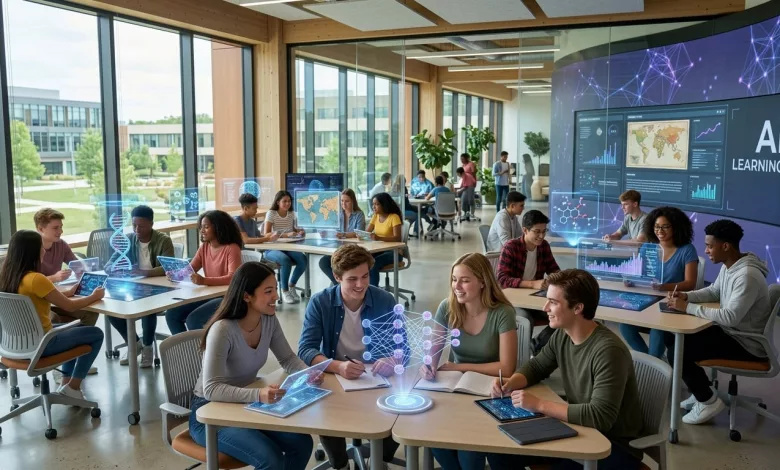
How AI Is Transforming Education: Promise and Peril
Artificial intelligence is moving from a flashy classroom experiment to a practical part of everyday education. Schools and universities are already using AI to draft lesson plans, generate practice quizzes, personalize reading materials, and support students who need extra help. In some cases, AI can act like a tireless teaching assistant: it can answer routine questions, flag learning gaps, and help educators spend more time on the human parts of teaching—motivation, mentorship, and relationship-building.
At the same time, the future of AI in education is not just about convenience. It raises big questions about what students should learn, how teachers should teach, and where the line should be drawn between support and dependence. The real story is not whether AI will enter education—it already has. The question is how wisely we use it.
Boomer Perspective
From an optimistic point of view, AI could make education more personal, efficient, and inclusive. One of its biggest strengths is adaptation. Instead of giving every student the same worksheet or lecture at the same pace, AI can tailor content to different skill levels. A struggling reader might get simpler explanations and extra vocabulary support, while an advanced student can move ahead to more challenging material.
AI also has the potential to reduce teacher workload. Educators spend hours on planning, grading, and administrative tasks that leave less time for direct instruction. If AI can help automate some of that work, teachers can focus more on coaching, discussion, and creative lesson design. For students, that could mean faster feedback, more practice opportunities, and a learning experience that feels less one-size-fits-all.
There is also a strong accessibility case. AI tools can assist students with disabilities, translate materials into other languages, and provide 24/7 support outside the classroom. In the best-case scenario, AI helps widen access to quality education rather than restrict it.
Doomer Perspective
The cautionary view is just as compelling. AI can make learning easier—but easier is not always better. If students rely too heavily on AI to generate answers, they may skip the struggle that builds deep understanding. Over time, that could weaken critical thinking, creativity, and problem-solving skills.
There are also risks around bias, privacy, and trust. AI systems learn from data, and data can reflect inequality. That means some tools may misjudge students, reinforce stereotypes, or work better for some groups than others. Schools also handle sensitive information, so the more AI is plugged into classrooms, the more important data protection becomes.
Another concern is that AI may widen the digital divide. Schools with money, strong infrastructure, and trained staff will benefit first, while under-resourced schools may fall further behind. And if students begin using AI to complete assignments without real understanding, academic integrity becomes much harder to measure.
A Balanced Take
The most realistic future sits between hype and fear. AI will not replace teachers, and it should not. But it can become a powerful tool when it is used to support human judgment rather than substitute for it. The best education systems will likely treat AI like a co-pilot: useful for guidance, speed, and scale, but never allowed to take the wheel completely.
In the end, AI’s impact on education will depend less on the technology itself and more on the values behind it. If schools prioritize equity, transparency, and teacher leadership, AI could make learning more personal and effective. If they chase efficiency without safeguards, they may trade short-term gains for long-term harm. The future of education will not be human or artificial. It will be the quality of the partnership between the two.